Introduction
We will prove that the regular heptadecagon, a polygon with 17 equal sides, is constructible with ruler and compass. It is enough to prove that the number $\cos\left(\frac{2\pi}{17}\right)$ is constructible. The procedure will follow the idea given by Gauss, who summed the roots of unity to express this quantity in terms of roots—Gaussian periods.
Expression in Radicals of $\cos\left(\frac{2\pi}{17}\right)$
Let $\zeta=e^{2\pi i/17}$, the primitive root of the polynomial
\[\begin{align} f(t)=t^{17}-1=(t-1)\left(t^{16}+\ldots+ t+1\right).\label{polf} \end{align}\]The field $\mathbb{Q}(\zeta)$ is a Galois extension of $\mathbb{Q}$ whose Galois group is isomorphic to the multiplicative group $\mathbb{Z}^*_{17}$. You can verify that $\mathbb{Z}^*_{17}=\langle 3\rangle$. If you are not familiar with Galois theory, the essence of this argument is that each time you multiply a primitive root by $\zeta$, you move to the next vertex of the heptadecagon in the counterclockwise direction.
| $n$ | $0$ | $1$ | $2$ | $3$ | $4$ | $5$ | $6$ | $7$ | $8$ | $9$ | $10$ | $11$ | $12$ | $13$ | $14$ | $15$ |
|---|---|---|---|---|---|---|---|---|---|---|---|---|---|---|---|---|
| $3^n \bmod 17$ | $1$ | $3$ | $9$ | $10$ | $13$ | $5$ | $15$ | $11$ | $16$ | $14$ | $8$ | $7$ | $4$ | $12$ | $2$ | $6$ |
Motivated by the fact that $\lbrace 0\rbrace=\langle 3^{16}\rangle\triangleright \langle 3^8\rangle\triangleright\langle 3^4\rangle\triangleright\langle 3^2\rangle\triangleright\langle 3\rangle$, we consider the cosets $\langle 3^2\rangle$ and $3\langle 3^2\rangle$ as a starting point to define the sums
\[\begin{align} x_1&=\sum_{k\in\langle 3^2\rangle}\zeta^k=\zeta+\zeta^9+\zeta^{13}+\zeta^{15}+\zeta^{16}+\zeta^8+\zeta^4+\zeta^2,\label{x1}\\ x_2&=\sum_{k\in 3\langle 3^2\rangle}\zeta^k=\zeta^3+\zeta^{10}+\zeta^5+\zeta^{11}+\zeta^{14}+\zeta^7+\zeta^{12}+\zeta^6,\label{x2}\\ y_1&=\sum_{k\in\langle 3^4\rangle}\zeta^k=\zeta+\zeta^{13}+\zeta^{16}+\zeta^4,\label{y1}\\ y_2&=\sum_{k\in 3^2\langle 3^4\rangle}\zeta^k=\zeta^9+\zeta^{15}+\zeta^8+\zeta^2,\label{y2}\\ y_3&=\sum_{k\in 3\langle 3^4\rangle}\zeta^k=\zeta^3+\zeta^5+\zeta^{14}+\zeta^{12},\label{y3}\\ y_4&=\sum_{k\in 3^3\langle 3^4\rangle}\zeta^k=\zeta^{10}+\zeta^{11}+\zeta^7+\zeta^6.\label{y4} \end{align}\]
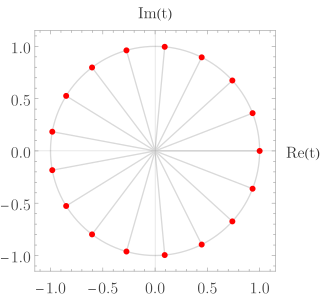
By the way these sums have been chosen in the complex plane —some summands are conjugate roots, we can state that $x_1,x_2,y_1,y_2,y_3,y_4$ are all real, and that $x_1>x_2,y_1>y_2,y_3>y_4$ —see the figure above. From \eqref{polf} we know that
\[x_1+x_2=-1.\]On the other hand, by reducing the powers modulo $17$ in the product we obtain
\[\begin{align*} x_1x_2 &=\zeta^{30} + \zeta^{29} + \zeta^{28} + 3\zeta^{27} + 2\zeta^{26} + 2\zeta^{25} + \zeta^{24} + 3\zeta^{23} + 3\zeta^{22} + 3\zeta^{21} \\&\quad+ 4\zeta^{20} + 4\zeta^{19} + 4\zeta^{18} + 4\zeta^{16}+ 4\zeta^{15}+ 4\zeta^{14} + 3\zeta^{13} +3\zeta^{12} + 3\zeta^{11} \\&\quad+ \zeta^{10} + 2\zeta^9 + 2\zeta^8 + 3\zeta^7 + \zeta^6 + \zeta^5 + \zeta^4\\ &=4\left(\zeta^{16}+\cdots+\zeta\right)\\ &=4(-1)\\ &=-4. \end{align*}\]It follows that $x_1$ and $x_2$ are roots of the polynomial
\[t^2-(x_1+x_2)t+x_1x_2=t^2-t-4.\]Hence,
\[\begin{align} x_1&=\frac{-1+\sqrt{17}}{2},\label{x1r}\\ x_2&=\frac{-1-\sqrt{17}}{2}.\label{x2r} \end{align}\]The goal from now on will be to repeat this procedure on $y_1,y_2,y_3,y_4$ in order to obtain their radical expressions. Similarly, for $y_1$ and $y_2$ we obtain that $y_1+y_2=x_1$ and
\[\begin{align*} y_1y_2 &=\zeta^{31} + \zeta^{28} + \zeta^{25} + \zeta^{24} + \zeta^{22} + \zeta^{21} + \zeta^{19} + \zeta^{18}\\&\quad + \zeta^{16} + \zeta^{15} + \zeta^{13} + \zeta^{12} + \zeta^{10} + \zeta^{9} + \zeta^{6} + \zeta^{3}\\ &=\zeta^{16}+\cdots+\zeta\\ &=-1. \end{align*}\]Therefore, $y_1$ and $y_2$ are roots of the polynomial
\[\begin{align*} t^2-x_1t-1. \end{align*}\]That is,
\[\begin{align} y_1&=\frac{1}{4}\left(-1+\sqrt{17}+\sqrt{34-2\sqrt{17}}\right),\label{y1r}\\ y_2&=\frac{1}{4}\left(-1+\sqrt{17}-\sqrt{34-2\sqrt{17}}\right).\label{y2r} \end{align}\]Likewise, $y_3$ and $y_4$ are roots of
\[\begin{align*} t^2-x_2t-1. \end{align*}\]Their expressions are
\[\begin{align} y_3&=\frac{1}{4}\left(-1-\sqrt{17}+\sqrt{34+2\sqrt{17}}\right),\label{y3r}\\ y_4&=\frac{1}{4}\left(-1-\sqrt{17}-\sqrt{34+2\sqrt{17}}\right).\label{y4r} \end{align}\]Finally, we define $\alpha$ and $\beta$ as
\[\begin{align*} \alpha&=\zeta+\zeta^{16},\\ \beta&=\zeta^4+\zeta^{13}. \end{align*}\]Repeating the same process, we obtain that $\alpha+\beta=y_1$ and $\alpha\beta=y_3$, so both are roots of the polynomial
\[\begin{align*} t^2-y_1t+y_3. \end{align*}\]Whence,
\[\begin{align} \alpha &=\frac{1}{8}\left(-1+\sqrt{17}+\sqrt{34-2\sqrt{17}}+2\sqrt{17+3\sqrt{17}-\sqrt{170+38\sqrt{17}}}\right),\\ \beta &=\frac{1}{8}\left(-1+\sqrt{17}+\sqrt{34-2\sqrt{17}}-2\sqrt{17+3\sqrt{17}-\sqrt{170+38\sqrt{17}}}\right). \end{align}\]Note that $\alpha$ is the sum of conjugate roots, so
\[\begin{align*} \alpha=2\Re\left(\zeta\right)=2\cos\left(\frac{2\pi}{17}\right). \end{align*}\]Thus, finally
\[\begin{align} \cos\left(\frac{2\pi}{17}\right) &=\frac{1}{16}\left(-1+\sqrt{17}+\sqrt{34-2\sqrt{17}}+2\sqrt{17+3\sqrt{17}-\sqrt{170+38\sqrt{17}}}\right).\label{cosrad} \end{align}\]Proving that indeed, this cosine is a constructible number.
Construction of the Field Tower
From the way we have constructed the cosine, the following field tower consists of quadratic extensions
\[\begin{align*} \mathbb{Q}\subseteq\mathbb{Q}(x_1)\subseteq\mathbb{Q}(y_1)\subseteq\mathbb{Q}\left(\cos\left(\frac{2\pi}{17}\right)\right). \end{align*}\]Which we can simplify as
\[\begin{align} \mathbb{Q}\subseteq\mathbb{Q}\left(\sqrt{17}\right)\subseteq\mathbb{Q}\left(\sqrt{34-2\sqrt{17}}\right)\subseteq\mathbb{Q}\left(\cos\left(\frac{2\pi}{17}\right)\right). \end{align}\]This agrees with the Gauss–Wantzel theorem.
References
- Stewart, I. (2015). Abstract Algebra: A Comprehensive Introduction (4th ed.). Chapman and Hall/CRC. https://doi.org/10.1201/b18187